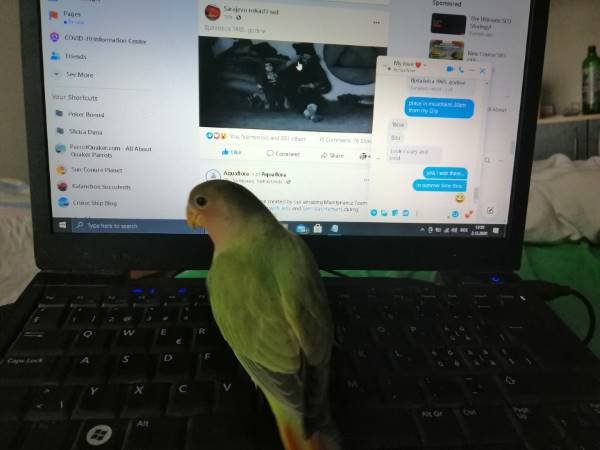
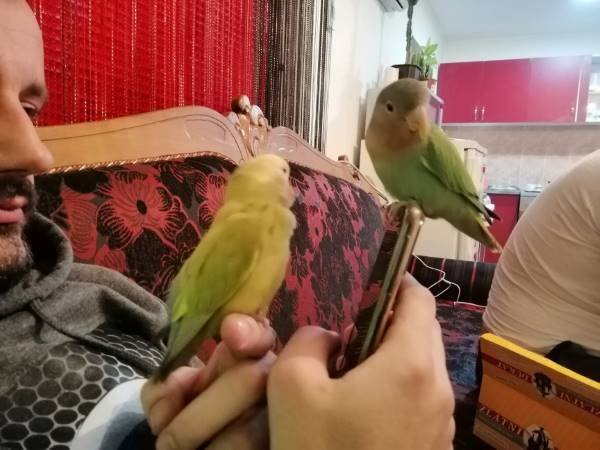
So, you’ve brought home a lovebird. They are cute, colorful, and full of personality. But unless you have a DNA test certificate in hand, you might be asking the big question: Is “Mango” actually a boy or a girl?
Unlike parakeets (where you can check the nose color) or peacocks (where the tail gives it away), most pet lovebirds, especially the popular Peach-faced, Fischer’s, and Masked species, look exactly the same. This is called being “sexually monomorphic.”
However, if you watch them closely, they often tell on themselves. Here is the “unofficial” pet owner’s guide to figuring out if you have a Hen (female) or a Cock (male) based on how they act.
1. The “Paper Strip” Test (Nesting)
If you give your bird a piece of paper, what happens next is often the biggest clue.
The “Tucker” (Almost Always Female)
If you have a Peach-faced Lovebird (Agapornis roseicollis), watch this closely. Does your bird shred paper into perfect, long strips like a hole puncher? More importantly, does she stick those strips into her tail feathers and fly around looking like a colorful porcupine?
This behavior is genetically hardwired into female Peach-faced lovebirds. They transport nesting material in their rump feathers to keep their beak free for climbing. If you see your bird successfully tucking strips and flying with them, you can be about 99% sure you have a girl.
The “Beak Carrier” (The Eye-Ring Species)
If you have a Fischer’s or Masked lovebird, they don’t usually do the tucking trick. Females of these species carry material in their beaks.
- Females: Will shred paper or collect twigs and carry them with determination to a specific spot.
- Males: Often act confused. They might chew the paper, play with it, or try to tuck it but drop it immediately. They are enthusiastic participants but usually terrible architects.
2. Personality: The Boss vs. The Lover
While every bird is an individual, long-time owners often notice a “vibe” difference between the sexes.
The Female: “The Queen of the Cage”
Female lovebirds are biologically driven to defend their nesting cavity. In your house, the “cavity” is her cage.
- Territorial: Females are often described as feisty, bossy, or nippy, especially when you put your hand in their space. If your bird lunges at you when you change the food bowl but is sweet once she’s out of the cage, that’s classic female behavior.
- The Bite: Owners often say females bite harder. They don’t just nip; they grind down to defend their territory. If you are struggling with this, you might want to read up on why lovebirds bite and how to stop it.
The Male: “The Laid-Back Buddy”
Males don’t have the same instinct to fight to the death for a nest hole.
- Temperament: They tend to be a bit more docile and less cage-aggressive. They are often described as more “even-tempered” year-round.
- The downside: A lonely male might become obsessed with his human or a toy, leading to some… awkward behaviors (see below).
3. “Romantic” Moves (Hormonal Behavior)
When spring comes (or just when you pet them the wrong way), their hormones kick in. The way they flirt is a dead giveaway, and understanding lovebird breeding behavior can help you manage it.
The Female: “Airplane Mode”
When a female lovebird is ready to mate, she adopts a very specific posture. She will lean forward, spread her wings out wide (looking like an airplane), and lift her tail high in the air. She might also make soft, rhythmic squeaking noises. This is her way of inviting a male to mount her.
The Male: The “Clicky Dance” & Regurgitation
Males have to work for it. Their flirting involves:
- The Head Bob: Rapidly bobbing his head up and down.
- Regurgitation: He might try to throw up seeds for you, a mirror, or a toy. It’s gross to us, but it’s the ultimate sign of love in the bird world (“Look, I can feed our babies!”).
- The Shuffle: He might do a little side-step dance along the perch while making clicking or twittering noises.
- Vent Rubbing: Males are much more likely to rub their bottoms on perches, toys, or even your hand. While females can do this too, it’s a hallmark of a frustrated male.
4. Sounds and Talking
There is a myth that only male birds talk. In lovebirds, neither sex is a great talker. They aren’t African Greys. Both males and females can learn to mimic whistles or simple noises, so don’t use talking ability to guess the gender.
However, there is a difference in their natural sounds and meanings:
- Males: Often have a sharper, higher-pitched, and more repetitive “metallic” chirp.
- Females: Often have a slightly lower, harsher, or more “grating” call.
5. The Pelvic Bone Myth (Don’t Trust It!)
You might read online that you can feel the width of a bird’s pelvic bones to tell the sex (wide = female, narrow = male). As a pet owner, avoid this. Unless you are a vet or an experienced breeder, it is very hard to feel correctly. Also, a female who has never laid an egg might have narrow bones, just like a male. It’s about as accurate as flipping a coin.
Summary Cheat Sheet
| Behavior | Likely a GIRL | Likely a BOY |
| Paper | Shreds & tucks into tail feathers (Peach-faced) | Shreds for fun, drops it, or looks confused |
| Posture | “Airplane wings” (wings out, tail up) | Head bobbing, scratching head with foot |
| Gifts | Accepts food | Tries to regurgitate food for you/toys |
| Cage | “This is MY house!” (Territorial/Nippy) | “Come on in!” (Generally more chill) |
| Nesting | Hides in dark corners, shreds everything | Less interested in building nests |
The only 100% guarantee: If your bird lays an egg, it’s a girl. (Yes, single birds can lay unfertilized eggs!). If you really need to know for sure before naming them, a simple DNA feather test from the vet is your best bet.